Boston Tea Party II? Global Trade War on Huge US Tariffs?
Published / Last Updated on 03/04/2025
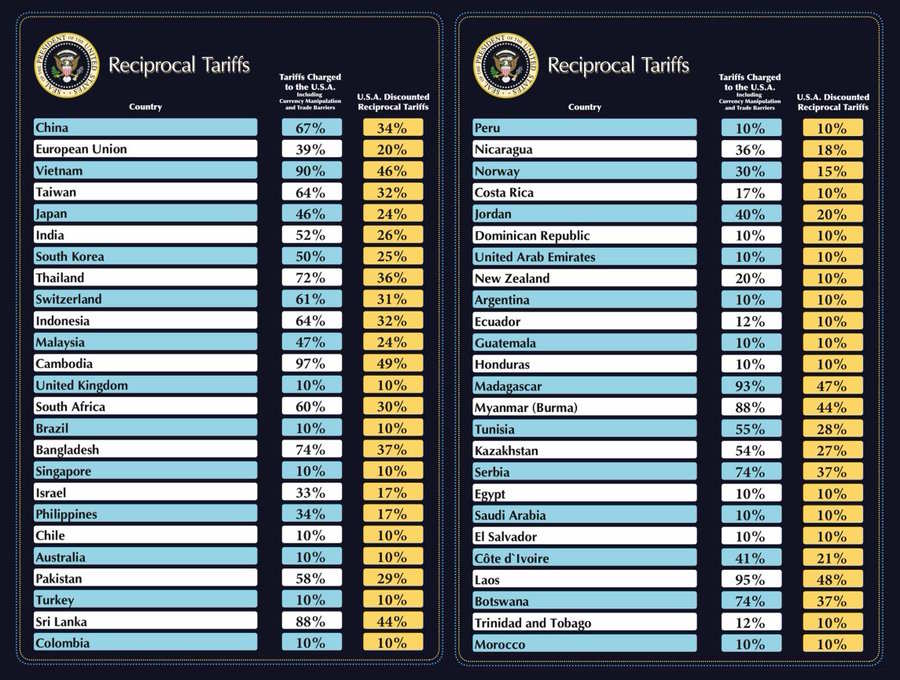
We had all been warned that Wednesday 2nd April would be a big day for US import tariff announcements and indeed it was.
President Trump signed off new customs tariffs for global exports going into the US. He brandished a huge black notice with yellow tariff figures for most of the globe.
President Trump sighted the fact that as well as strangling US businesses by other countries exporting cheaper goods and services, there is also an element of currency manipulation to make exports into the US cheaper and imports from the US more expensive in certain countries.
The tariff table highlighted the effects of currency manipulation and trade barriers by certain countries meaning with the manipulation ‘weighting’ their goods were cheaper in the US but US consumers still paying more than consumers in their host countries are paying for the same goods with the knock-on effect of US goods also becoming too expensive in those said countries.
(Image source: x.com/whitehouse)
Comment
Is this the Boston Tea Party II?
Not quite. The UK faired relatively well given we have net neutral imports/exports trade balances with the US. The US judging the UK to have 10% trade barrier issues meaning a reciprocal 10% US customs tariff.
That said, the 25% tariff on global car imports will hurt the UK but nowhere near the pain that France, Germany, Italy Spain, and Japan will suffer.
This is a big gamble by the President to balance the trade deficit. We know that this has been on his wish list for some time having already left a number of unilateral free trade agreements as well as the Paris Climate Agreement. This is all designed to boost US domestic trade, construction, and car manufacturing but we have fears for construction with Canadian timber imports having 14.54% duties but with the additional 25% imposed on Mexico and Canada, lumber tariffs could hit nearly 40%. “Bye bye” construction and of course, toilet paper shortages.
That said, if the gamble pays off, US domestic markets will prosper as more Americans will buy American. It will also dramatically reduce the US trade deficit meaning more $ stay in the US rather than wealth ‘bleeding out’ of the US but we do fear for inflation.
Prices globally will rise meaning interest rates will stay high but is this by design? Never forget, higher inflation also devalues public sector debt. With inflation say at 5% pa, say over a 10-year period, that’s 62.88% compounded, meaning existing US debt is reduced in real terms by nearly 63%, and if inflation were then to settle at say 3% pa for another 10 years, that’s another 34.39% compounded. Over a 20-year period that’s a compounded 84.50% reduction in the real time value of current US debt.
The numbers:
|
Country |
Weighted ‘Tariffs’ charged to US after currency manipulation and trade barriers |
USA Reciprocal Tariffs |
|
Cambodia |
97% |
49% |
|
Laos |
95% |
48% |
|
Madagascar |
93% |
47% |
|
Vietnam |
90% |
46% |
|
Sri Lanka |
88% |
44% |
|
Myanmar (Burma) |
88% |
44% |
|
Bigger Exporters to US (ex Canada/Mexico – tariffs already in force) |
|
|
|
China |
67% |
34% |
|
European Union |
39% |
20% |
|
Taiwan |
64% |
32% |
|
Japan |
46% |
24% |